
👻 Obscure | SAT Vocabulary That Leaves You in the Dark
Do you know it already? OBSCURE most nearly means: A) prominent; B) little-known; C) offensive; D) ancient. Answer inside. 👉️
Mnemonic: To remember this word, I like to tell my local students about the Camera Obscura (literally 'room/chamber' + 'dark') we have here in San Francisco. It's basically a giant pinhole camera—you walk into it, and you can see the image in front of it projected onto the wall.
📚️ Definition of Obscure
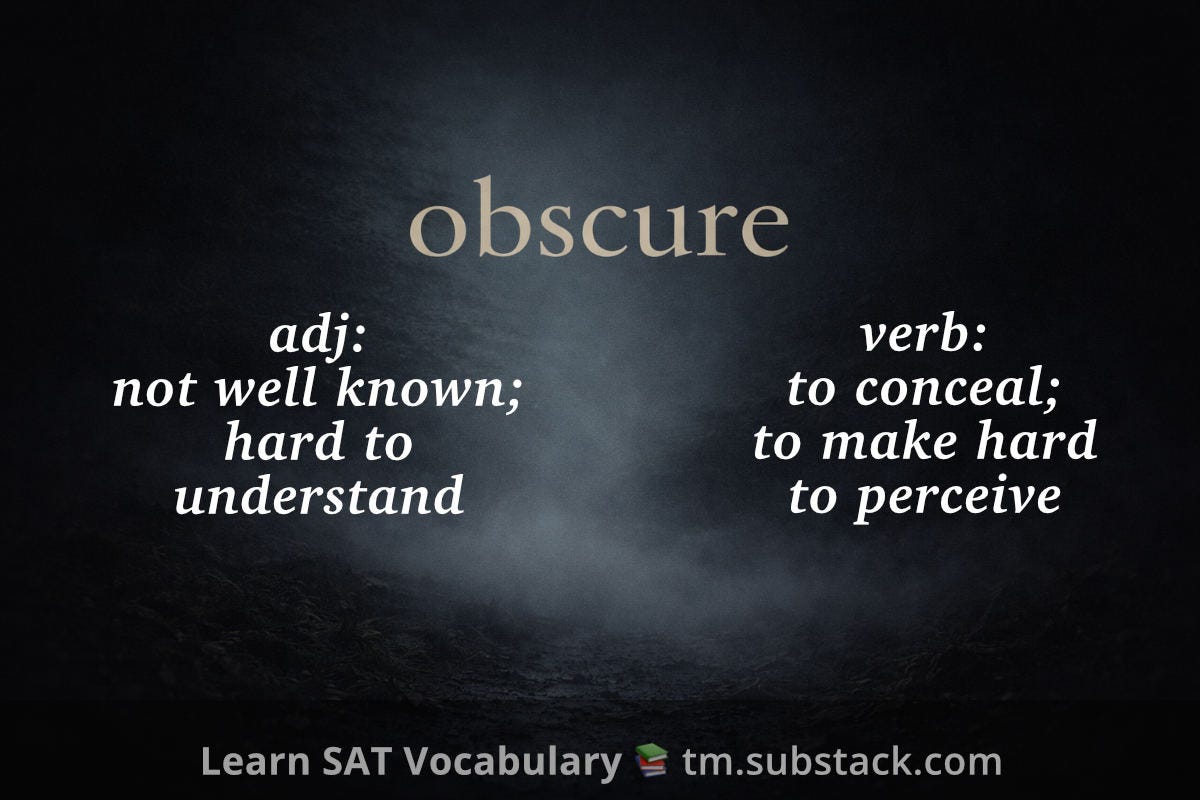
Obscure (adjective): Not well known, recognized, or understood by most people; difficult to see, find, or make sense of. Example: an obscure reference that no one understood.
Obscure (verb): To make something difficult to see, hear, or understand; to conceal or hide from view. Example: to obscure one’s identity online.
🗣️ Pronunciation of Obscure
IPA: /əbˈskjʊr/ (See IPA key)
Respelling: uhb-SKYOOR
📰 Examples of Obscure
Here are some examples of the word obscure:
The documentary explored the obscure history of a small desert town that played a pivotal role in the space industry.
Before she gained fame, Emily Dickinson was an obscure poet who had published only a handful of her nearly 1,800 poems during her lifetime.
“The obscure we see eventually. The completely obvious, it seems, takes longer.” — Edward R. Murrow
Quiz answer: B, little-known.
🧠 Summary of Obscure
Definition: As an adjective, obscure means not widely known or difficult to understand. As a verb, it means to hide or make unclear.
Examples: An obscure indie band few have heard of, an obscure passage in a textbook that’s hard to fully understand, or clouds that obscure a view.
Real-world connection: The internet has made it easier to discover obscure music, films, and hobbies.
SAT relevance: Obscure is a high-frequency SAT word that can appear as both an adjective and a verb in vocabulary-in-context questions. The SAT may also test whether you can distinguish it from near-synonyms like ambiguous or esoteric.