
Obviate — Actually Useful SAT Vocabulary
OBVIATE most nearly means: A) preclude; B) exacerbate; C) corroborate; D) enumerate. Answer inside.
I actually love this word because it’s really useful, and when you OBVIATE, you avoid future problems.
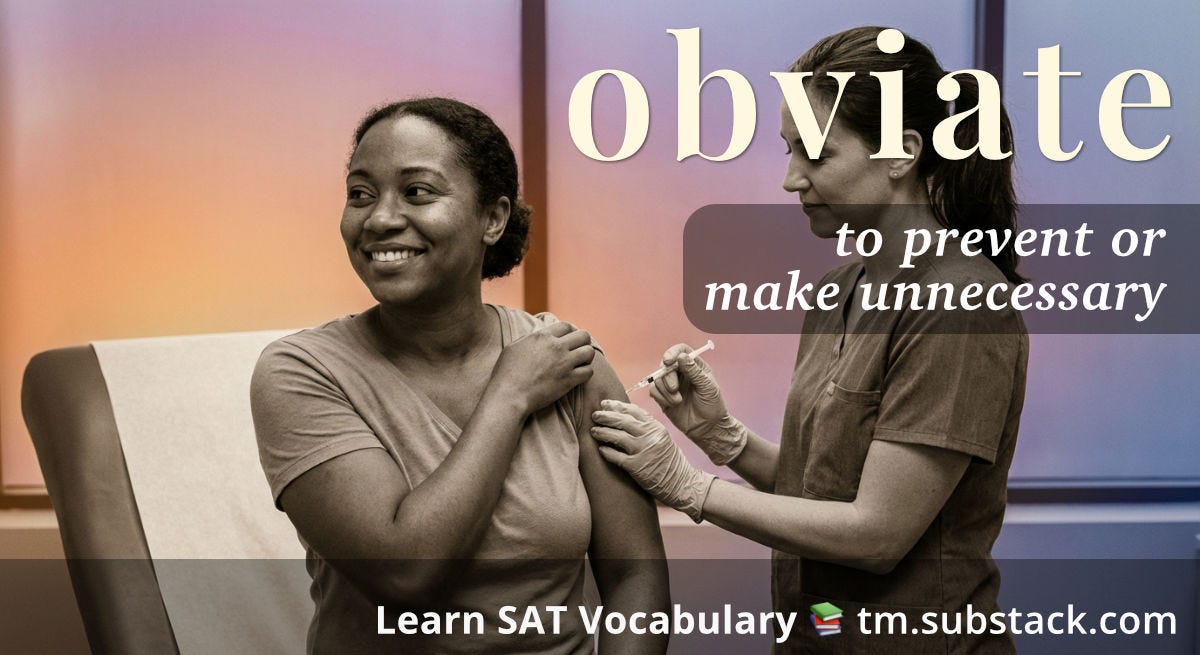
📚️ Definition of Obviate
Obviate (verb): To anticipate and prevent a difficulty, disadvantage, or need by taking effective action, thereby making it unnecessary to deal with. Example: a policy written so as to obviate arguments about costs in the future.
🗣️ Pronunciation of Obviate
IPA: /ˈɑb.vi.eɪt/ (See IPA key)
Respelling: AHB-vee-ayt
📰 Examples of Obviate
Here are some examples of the word obviate:
The update to the software that allowed HEIC uploads obviated the need for users to convert their images manually.
The invention of the printing press obviated the tedious and time-consuming process of hand-copying manuscripts.
Establishing clear definitions at the start of any inquiry will obviate many subsequent misunderstandings.
Don’t confuse obviate with mitigate. A good helmet mitigates a head injury; it lessens the damage. But keeping a watchful eye while crossing the street obviates the injury altogether. One reduces harm; the other erases the possibility of it. That difference could absolutely show up on a test.
Quiz answer: A, preclude.
🧠 Summary of Obviate
Definition: Obviate means to prevent or eliminate a difficulty or need entirely by acting in advance, making it unnecessary to deal with at all.
Real-world connection: Technology constantly obviates old problems — GPS obviated the need for paper maps, for example. Anytime something makes a former hassle vanish, that’s obviate.
Examples: Good planning obviates last-minute crises [note that this is the plural form of crisis], and a clear syllabus obviates endless questions on the first day of class. The idea is prevention in advance.
SAT relevance: Obviate is a relatively high-frequency word in academic and professional writing. It could appear in reading passages about science, policy, or history, or as a vocabulary-in-context question.