
30 SAT Question Words You Need to Know
You can understand the passage and still miss the question if you misunderstand one of these words.
Bonus information today, which comes from a massive project I’ve been working on behind the scenes: SAT vocabulary that is absolutely vital to know but doesn’t always show up in the vocabulary and context questions themselves.
30 Words You Need to Understand SAT Questions
Most vocabulary lists focus on difficult words in the reading passages. This list is different: these are words that appear in the questions and answer choices themselves.
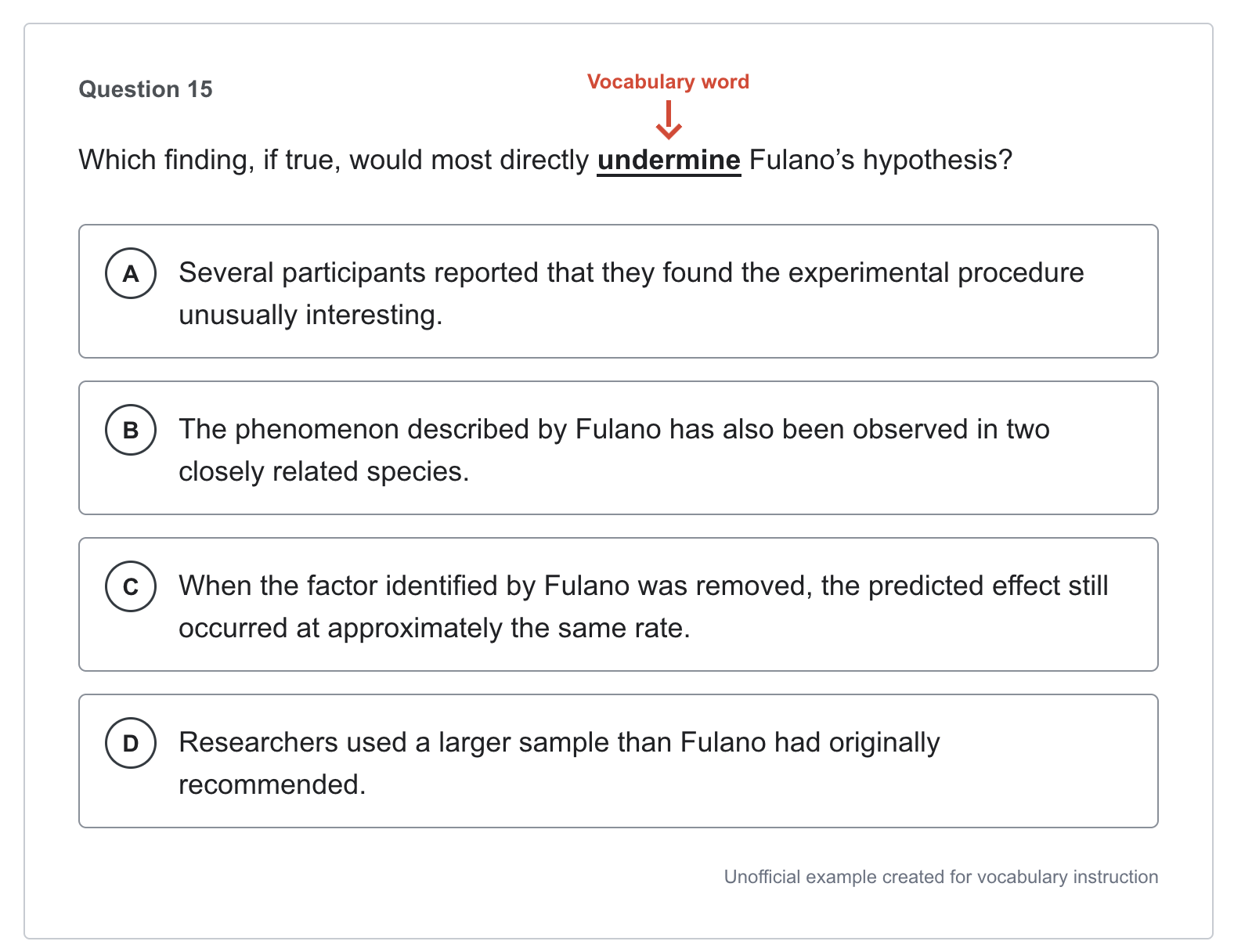
Most vocabulary lists focus on difficult words in the reading passages. This list is different: these are words that appear in the questions and answer choices themselves.
You can understand a passage perfectly and still miss the question because you misunderstood what undermine, corroborate, or qualify was asking you to find. These words describe the relationships among claims, evidence, and ideas—the basic machinery of SAT Reading and Writing questions.
A few of them are especially treacherous because they look familiar. Students often assume that qualify means “confirm,” that complicate means “cause a problem,” or that infer and imply are interchangeable. They aren’t.
Learn these words well enough that you recognize them instantly. The question should be testing your reading, not whether you understood the question.
Supporting or Undermining an Argument
undermine — weaken a claim or argument
refute — prove that a claim is wrong
rebut — respond directly to a claim by arguing against it
corroborate — confirm a claim with independent evidence
bolster — strengthen an argument that is already there
substantiate — support a claim with evidence or proof
validate — confirm that something is true, reasonable, or sound
discredit — damage the credibility of a claim, source, or person
contradict — say or show the opposite of something
Qualifying, Conceding, and Complicating
These are nuance words, which is exactly why students miss them. They often describe an author making a claim more precise—not abandoning it.
qualify (see note below) — limit a claim or add a condition or exception to it; it does not mean “confirm”
concede (see note below) — admit that a point is true, often one that weakens your own position
reconcile — explain how two apparently conflicting ideas can both be true
complicate — show that an issue is less simple than it first appeared; it does not merely mean “cause a problem”
reinforce — make an existing idea, conclusion, or impression stronger
Describing What a Sentence or Paragraph Does
These words often appear in questions that ask what a sentence “primarily functions to do.”
illustrate — explain an idea by giving a concrete example
exemplify — serve as a clear or typical example of something
convey — communicate an idea, impression, or feeling
imply — suggest something without stating it directly; the writer or text implies
infer — reach a conclusion from evidence; the reader infers
posit — put forward an idea or claim for consideration
assert — state something firmly or confidently
characterize — describe the essential nature or qualities of something
delineate — describe or lay something out precisely
attribute — identify something as the result of a particular cause or source
juxtapose — place two things side by side, usually to emphasize a contrast
analogous — comparable in a relevant or revealing way
corollary — a result or conclusion that follows naturally from another idea
Tone and Stance
These words describe the author’s attitude, level of certainty, or relationship to the subject.
ambivalent — having genuinely mixed or conflicting feelings
objective — based primarily on facts rather than personal feelings or judgments
subjective — shaped by personal feelings, experiences, or opinions
hypothetical — proposed or imagined for the sake of discussion, rather than presented as something that actually happened
Two Words That Deserve Extra Attention
Qualify and concede are notorious traps with students in my experience; each word has a nuanced meaning that some students will overlook.
To qualify a claim is to limit it, narrow it, or add an exception:
Exercise improves health.
Qualified: Exercise generally improves health, although the benefits definitely depend on the type of exercise and intensity.
To concede a point is to admit that part of the opposing argument is true:
The proposed change in the policy may be expensive at first, the author concedes, but over time, it could save tax-payer money.
Neither word means that the author has abandoned the original argument. In fact, acknowledging limits or admitting a fair point often makes an argument more credible to many readers.
Before You Go
You do not need to memorize every difficult word that might appear on the SAT. You do, however, need to know the words the test uses to tell you what it wants.
Pay particular attention to pairs of words that students routinely confuse: infer and imply, refute and rebut, objective and subjective. And do not assume you know a word just because it looks familiar. Qualify, for example, does not mean “confirm.” (For example, an unqualified success is a complete success.)
Learn a few of these at a time, and you’ll start seeing them in questions and feel more confident answer them.